
Barefoot Is Not a Trend
For most of human history, people walked, ran and worked barefoot or in simple, minimal footwear.
That history spans more than 200,000 years.
By comparison, modern cushioned shoes have existed for roughly five decades.
The contrast invites a basic question: what is “normal” movement? That shaped by human evolution, or that shaped by modern footwear design?
This distinction is not about nostalgia. It is about anatomy.
A Foot Designed to Function
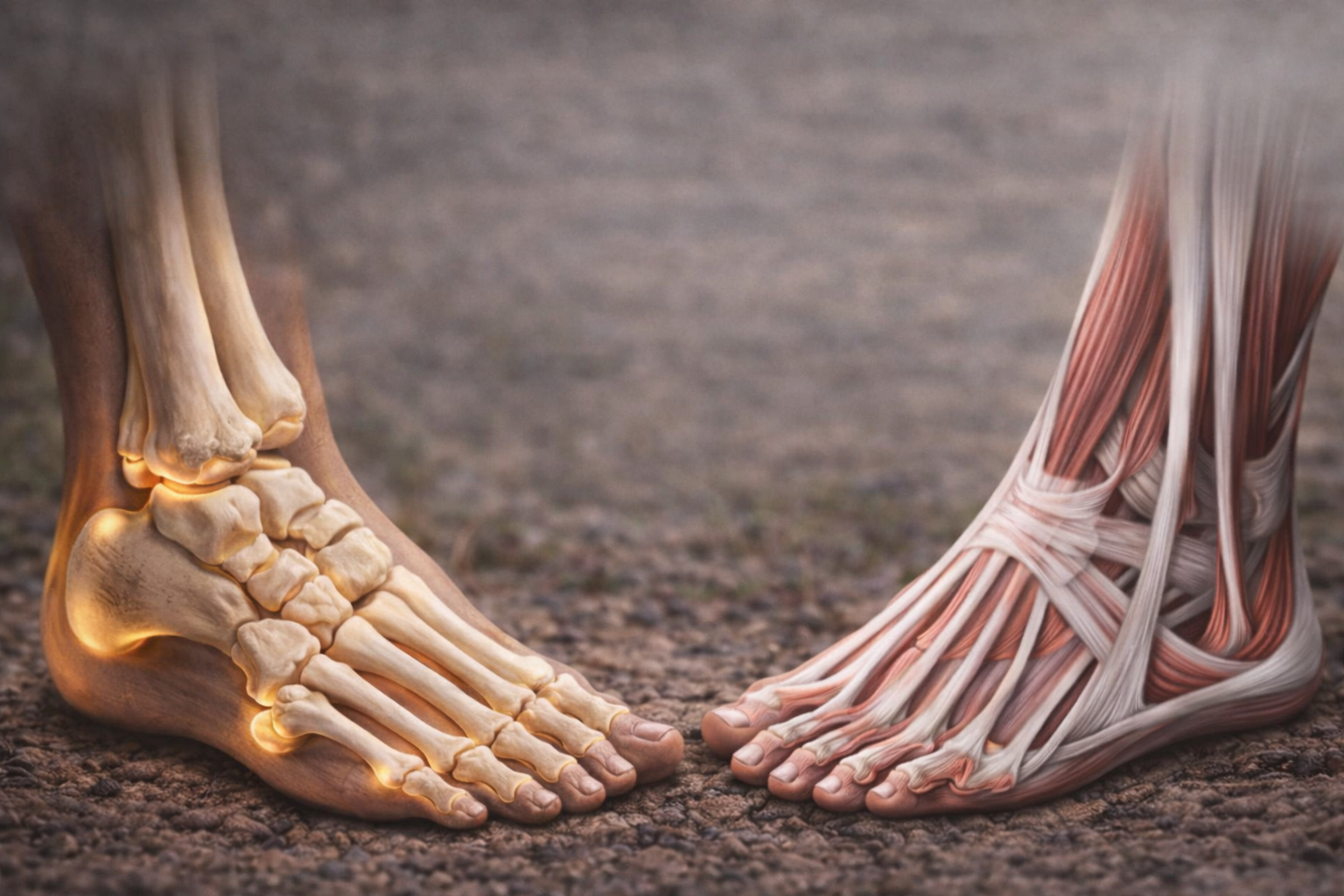
The human foot is a complex mechanical system.
It consists of 26 bones, 33 joints, more than 100 muscles, tendons and ligaments, and thousands of nerve endings.
Together, these structures provide balance, sensory feedback, shock absorption and stability.
When they are allowed to work, they adapt and strengthen. When they are restricted, they weaken.

The Effects of Modern Shoes
Most conventional shoes promise comfort.
But comfort comes with trade-offs.
They restrict foot movement, elevate the heel, alter posture, compress the toes, and dull sensory feedback from the ground. Over time, they teach the body to move differently.
If a shoe does the work, what happens to the body that no longer does?

Evidence, Not Ideology
Research continues to show that barefoot and minimal footwear can improve foot strength, balance, stability and sensory awareness through natural mechanics.
This isn’t ideology.
It’s biomechanics.
Reintroducing Natural Movement
Returning to barefoot movement does not require sudden change.
Gradual exposure:
- Spending time barefoot at home,
- Taking short walks in minimal shoes,
- Rebuilding foot strength and mobility
Feet respond to use, like any other part of the body.
The BAREBOUND Idea
Barefoot isn’t about what you wear.
It’s about what you allow.
The choice starts at your feet.